
Some People Keep Razor-Sharp Minds Into Their 80s and Beyond. A New Study Reveals Their Secrets
Scientists Unlock Secret - “Super-agers” seem to produce more new nerve cells in a brain region important for memory than other people their age.

By Sara Hashemi
July 6, 2026
Neuroscientists have long struggled to understand whether the adult human brain spawns new nerve cells, or neurons.
The process, called neurogenesis, is crucial during development, and rodent research in the 1960s hinted that the mature brain might undergo it as well.
Neurogenesis is the process by which new neurons are formed in the brain. Neurogenesis is crucial when an embryo is developing, but also continues in certain brain regions after birth and throughout our lifespan.
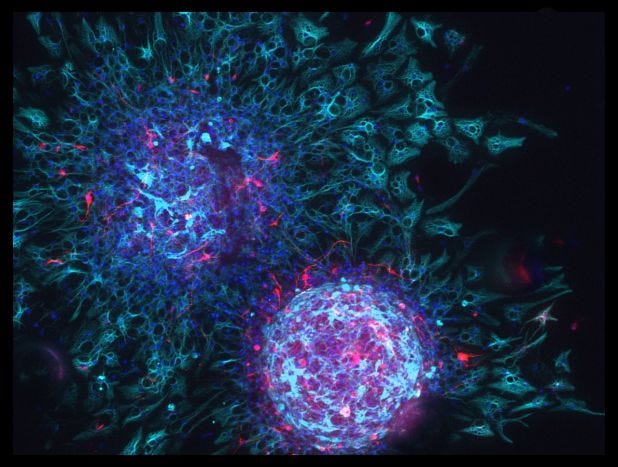
Neural stem cells can produce new neural cells of any type. When stem cells from the brain are isolated and grown in a dish, they continuously divide and create large spherical masses of cells, similar to the two shown here. Each spherical mass, called a neurosphere, is produced by a single stem cell. When exposed to different chemicals, the cells turn into either neurons (red) or glia (cyan). Cell nuclei are shown in dark blue. (Image: Chanel Taylor / QBI)
Mounting evidence since then has suggested that some animals, including rodents and nonhuman primates, experience adult neurogenesis, but humans have remained at the heart of a contentious debate.
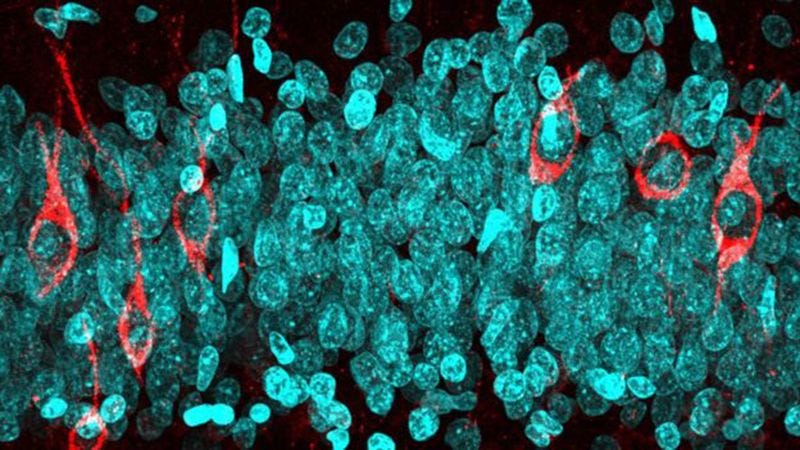
Immature (red) and mature (blue) neurons in the hippocampus of a 68 year-old Elena P. Moreno-Jiménez
Now, a new analysis of 38 human brains supports the idea that adults do, indeed, birth neurons—and that replenishing these cells might help preserve certain cognitive functions.
In a study published February 25 in the journal Nature, adults ages 80 and older with outstanding memory—dubbed “super-agers”—had twice as many new neurons in their hippocampi, a brain region crucial for memory, as older adults with normal memory for their age, and two and a half times as many as people with Alzheimer’s disease.
“This shows the aging brain has the capacity to regenerate—that’s huge,” says study co-author Tamar Gefen, a clinical neuropsychologist at Northwestern University Feinberg School of Medicine, to Sandee LaMotte at CNN.

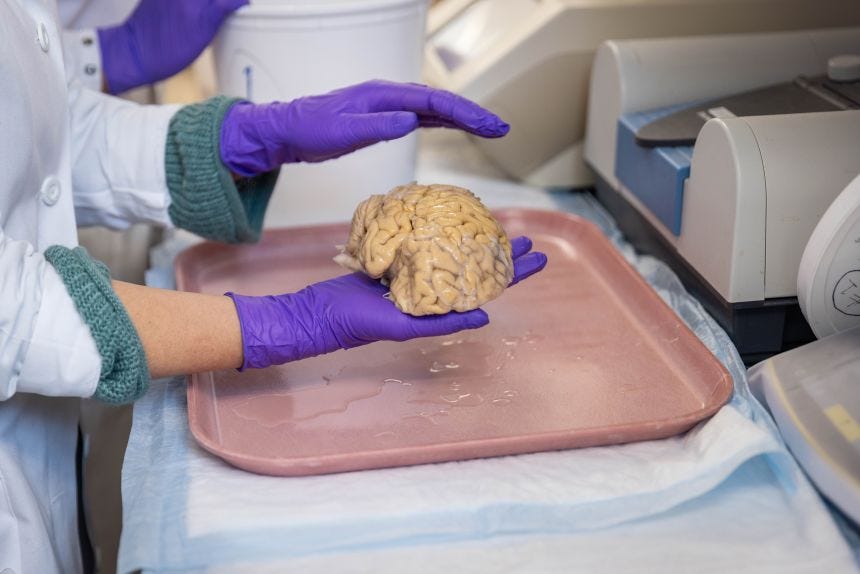
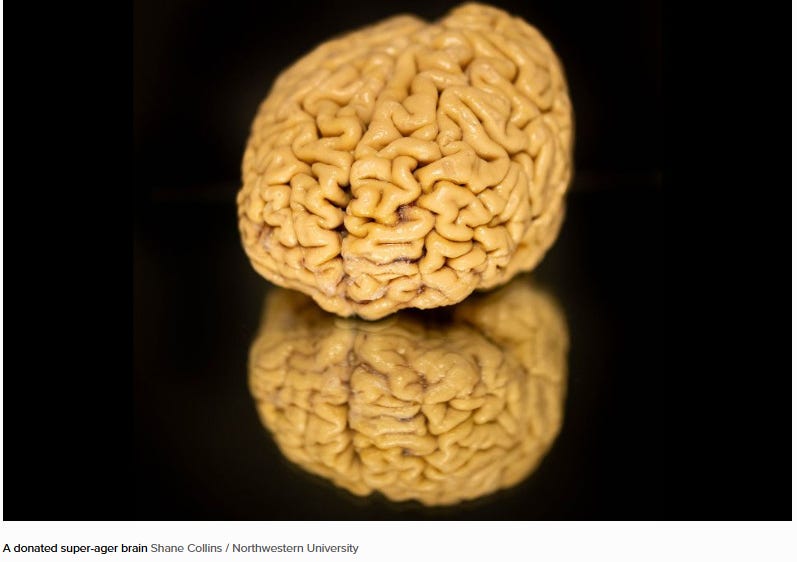
Researchers at Northwestern University have been studying the brains of SuperAgers for 25 years. From Shane Collins/Northwestern University
Need to know: When does most neurogenesis happen?
The human brain stays busy making new neurons during early embryonic development and infancy, but the activity sharply declines during childhood
Super-agers can recall everyday events and past personal experiences as easily as people decades younger, in their 50s, but have IQ levels comparable to those of others their age.
In the study, the researchers examined donated brains from members of this special group, as well as those from four other classes: older adults with no cognitive problems, older adults with mild or early dementia, older adults with Alzheimer’s disease and younger adults ages 20 to 40 with intact memory.
The young brains helped Gefen and her colleagues find genetic markers of several types of baby neurons, which were subsequently identified in all the older adults’ brains.
However, super-agers had way more of these immature cells in their hippocampi than the other elderly people—and even some of the younger adults.
What’s more, nerve cells called CA1 neurons and support cells called astrocytes seem to play important roles in super-agers’ extraordinary cognition, the researchers found. CA1 neurons help form, consolidate and retrieve memories, while astrocytes help neurons build connections with one another—which allow them to communicate—and seem to stabilize memories.
“What’s emerging from this study is this idea that super-agers are, in general, very distinct,” says study co-author Changiz Geula, a neuroscientist at Northwestern University Feinberg School of Medicine, in a statement.
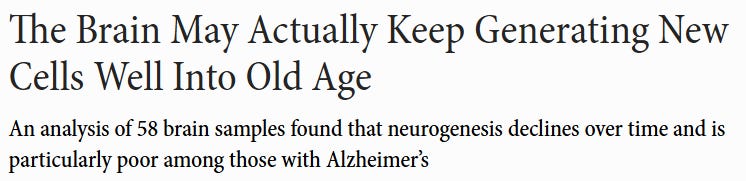
As Superagers Age, They Make at Least Twice as Many New Neurons as Their Peers
“The genetic programs that support brain cell survival and communication stay on in super-agers in these cells, but they’re switched off in Alzheimer’s disease.”
Still, some experts have reservations.
Shawn Sorrells, a neuroscientist at the University of Pittsburgh who wasn’t involved in the work, says that the new study and others that point to adult neurogenesis in humans are based on indirect evidence.
“We don’t actually see one cell physically changing into the next cell,” he tells Avery Hurt at National Geographic.
Additionally, each analyzed group included ten or fewer individuals, which is a major limitation, Maura Boldrini Dupont, a neuroscientist and psychiatrist at Columbia University, tells Mariana Lenharo at Nature.
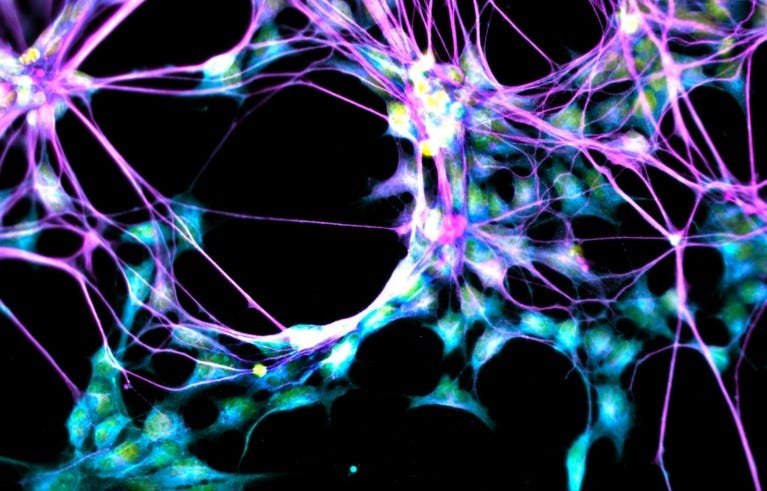
In neurogenesis, neural stem cells (shown here) can become neurons. Riccardo Cassiani-Ingoni/SPL
While the new study hasn’t settled the debate on adult neurogenesis, it has pushed forward our understanding of the human brain.
The next step would be to examine the roles of the adult brain’s newborn neurons, although this would require new research techniques, study co-author Orly Lazarov, a neuroscientist at the University of Illinois Chicago, tells Nature.
“What we need is functional validation of these cells, to tell what they’re doing in the human brain.”

READ MORE:
The Blood Pressure Medication That Could Increase People’s Lifespans
Study Finds Handwriting Increases Brain Connectivity

BOTTOMLINE
Groundbreaking study on “super-agers”—people aged 80 and older who maintain exceptionally sharp memories comparable to those of people in their 50s provides biological evidence for why some people defy typical age-related cognitive decline.
It focuses on adult hippocampal neurogenesis (the birth of new neurons in the hippocampus, a brain region critical for memory formation, consolidation, and retrieval).
Researchers examined postmortem brain tissue from 38 donors across five groups using advanced multiomic single-cell sequencing (analyzing gene activity and DNA accessibility in nearly 356,000 individual cell nuclei):
Main results:
SuperAgers showed a distinct “resilience signature” in the hippocampus.
They produced twice as many new/young neurons as cognitively healthy older adults and 2.5 times as many as people with Alzheimer’s disease.
In some markers, they even exceeded levels seen in younger adults.
Their brains had fewer tau tangles (a hallmark of Alzheimer’s) and featured a supportive cellular environment, particularly involving astrocytes (which aid synapse formation) and CA1 neurons (key for memory consolidation and retrieval).
Genetic programs supporting brain cell survival and communication remained active in SuperAgers but were often “switched off” in Alzheimer’s cases.
The new study highlights a biological mechanism—enhanced neurogenesis and a resilient hippocampal environment—as a core reason some brains stay sharp.
Importantly, SuperAgers are not uniform—some have health issues like heart disease or diabetes—suggesting their brain biology confers significant protection.
In short, the “secret” revealed by this study is sustained production of new neurons in the memory center of the brain, giving SuperAgers a biological edge.
Combined with an engaged, socially connected lifestyle, it offers real hope and actionable insights for healthy brain aging.
Share or comment on this article.
Your support is crucial in exposing fake news and in helping us defeat mass censorship.